 September 01, 2026
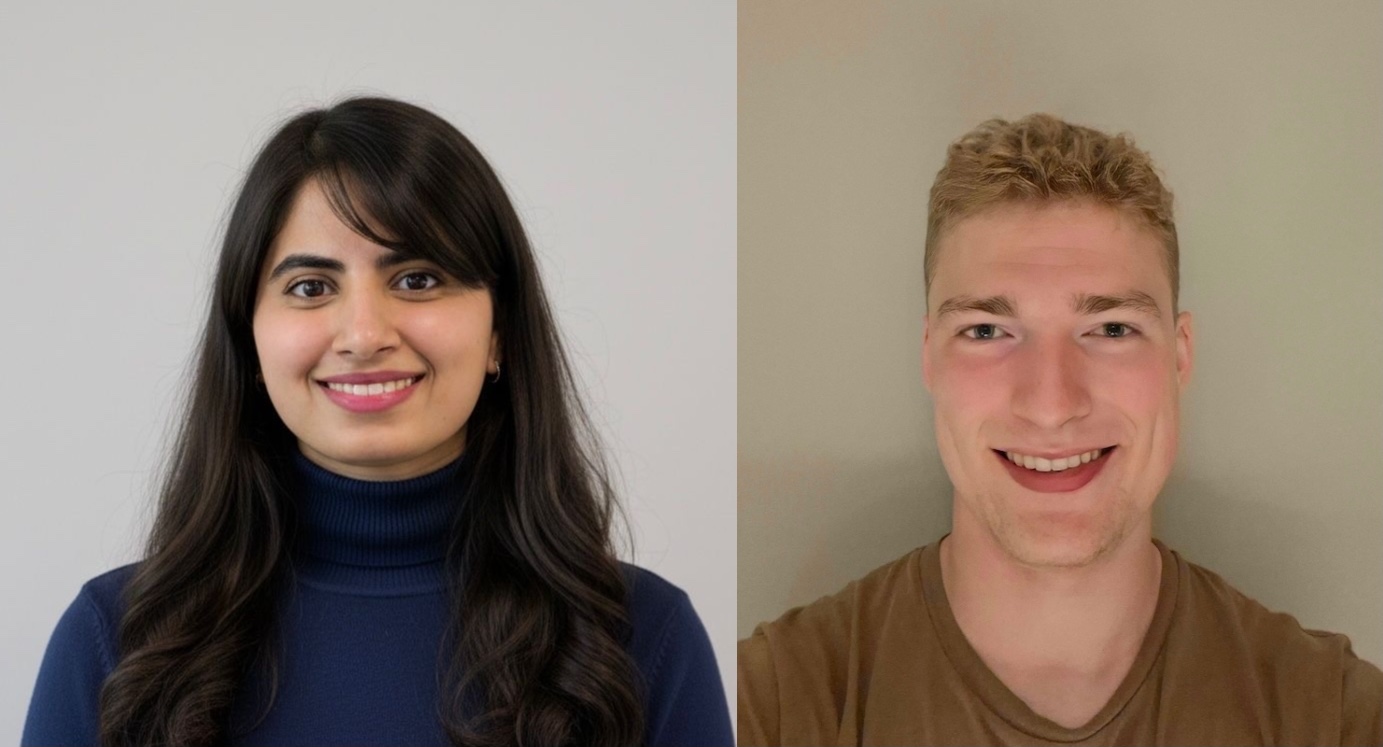
The first two new PhD students arrive in Amsterdam.
None
 September 01, 2026
The first two new PhD students arrive in Amsterdam.
None
 August 20, 2026
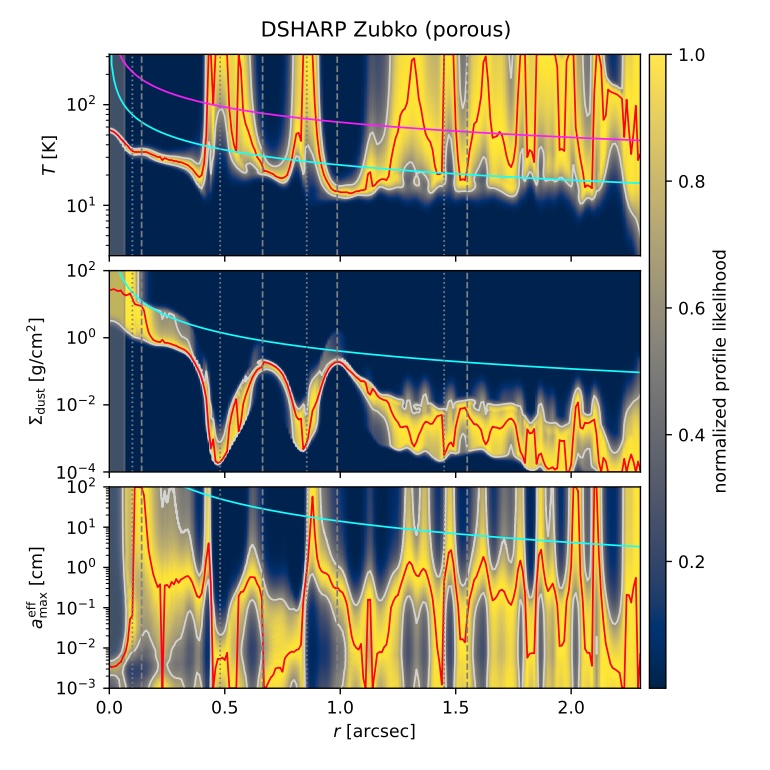
Context. Planets form through the growth and accumulation of dust grains in protoplanetary disks. Characterizing dust properties such as size, surface density, and temperature is key to understanding planet formation. Aims. We characterize the dust properties of the protoplanetary disk around HD 163296 by performing spectral energy distribution (SED) fitting of multi-wavelength high-resolution observations. Methods. We present new high-resolution ALMA Band 9 (0.45 mm) observations, which are sensitive to the temperature. We performed SED fitting at a common resolution of 0.066 arcsec using these new Band 9 observations along with archival ALMA Band 3, 4, 6, and 7 observations. We compared the fitted results with VLA observations and explored multiple dust models with different optical constants and porosities. Results. The Band 9 image shows the central disk, two rings at 0.67 and 1.00 arcsec, and outer extended emission previously seen at other wavelengths. At higher frequencies, the rings appear wider, the gaps appear shallower, and the extended emission appears brighter, which can be explained by optical-depth effects and/or size segregation. We characterized the dust properties, including temperature, surface density, and dust size, for each dust model. However, the inferred dust properties are dependent on the dust model, and the ALMA data alone do not allow us to determine which dust model is preferred. We identified the DSHARP Zubko (porous) model as the preferred model based on VLA profiles and physical and observational constraints. The outer ring temperature is lower than predicted by a passively irradiated disk model, suggesting shadowing by the inner ring. Although the surface density and dust size depend on the dust model, the preferred model indicates that the central disk, both rings, and the extended disk each contain more than a few Earth masses of dust.
Doi et al. 2026, A&A, in press.
 May 05, 2026
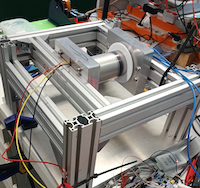
In the laboratory in Braunschweig, work on the enjection mechanism for dust into the vacuum chamber is progressing.The dust injection mechanism relies on a cogwheel thta spins at around 8000RPM. Calvin Knoop and the technical team at the University of Braunschweig are developing the mechanism so that it will be ready for use when the vacuum chanber arriges in Braunschweit in September 2026.
Credit: Dominik.
 May 05, 2026
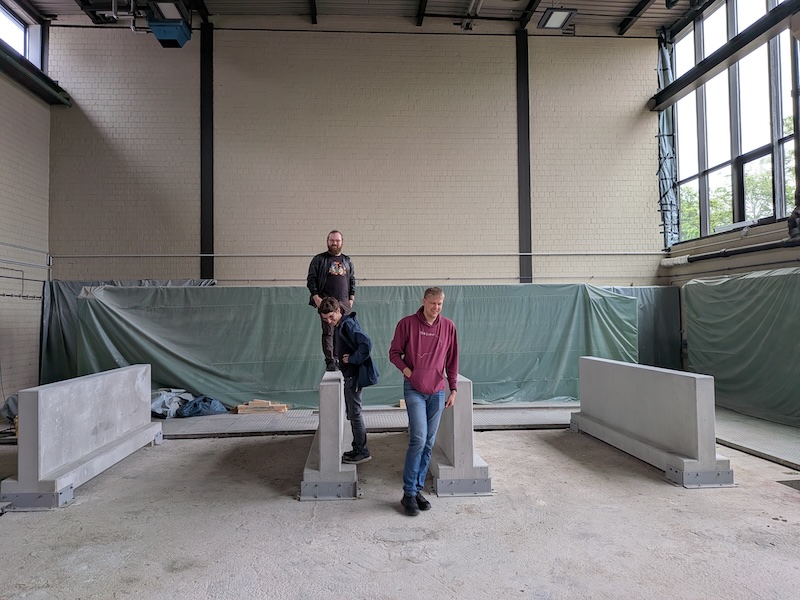
In the new experimental laboratory hall, the foundation for the levitation drum has been placed. On the picture Christopher Kreuzig, Calvin Knoop and Max Timpe
None
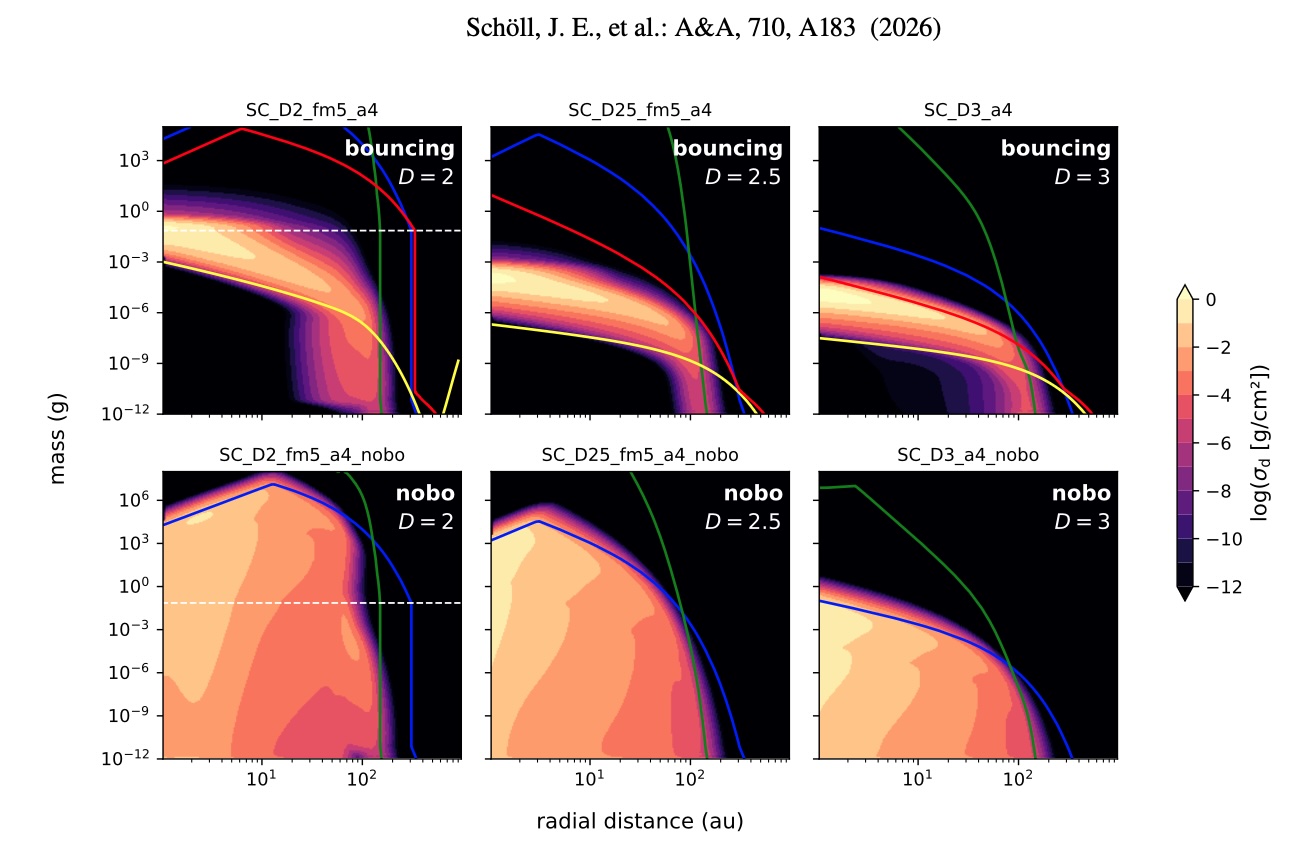 April 17, 2026
Context. During the first stages of dust coagulation in protoplanetary disks, the dust aggregates are expected to have a high degree of porosity. Most models of dust growth, however, do not take this into account. The reason for this is the technical complexity of this problem. Furthermore, the coagulation kernel for colliding porous or fractal dust aggregates is not well understood. Aims. We wish to explore the effect of aggregate porosity on the evolution of the dust population in protoplanetary disks, with an emphasis on the fragmentation and the bouncing barrier. Methods. We use the DustPy code, and implement porosity as a prescribed function of particle mass with the fractal dimension as a free parameter. In this way, we parameterize the ill-constrained physics of colliding porous or fractal aggregates, and we can explore the effect of different porosity prescriptions. We take into account the effect of porosity on the dust dynamics, while neglecting its effect on the collision outcomes. Results. We find that larger particle masses are reached for lower fractal dimensions. The maximum Stokes numbers that are reached do not depend on the fractal dimension in the case of fragmentation-limited growth and decrease with decreasing fractal dimension in the case of bouncing-limited growth. Furthermore, particle growth is slower for smaller fractal dimensions in our models. Conclusions. Dust evolution is strongly influenced by the fractal dimension. Although larger masses are reached for smaller fractal dimensions, the particles are still much smaller than planetesimals. Under the assumption that the bouncing and fragmentation velocities do not depend on the fractal dimension or filling factor, fractal growth is not beneficial for the streaming instability to occur in the case of fragmentation-limited growth and even disadvantageous in the case of bouncing-limited growth.
Schöll, Dullemond and Dominik 2026, A&A 710, A183.
 October 04, 2025
We are looking for three outstanding candidates for PhD positions at the Anton Pannekoek Institute for Astronomy at the University of Amsterdam.
Pebbles are the critical ingredient of all current planet formation models. Pebbles are large, compacted dust aggregates that are supposed to form early on in protoplanetary disks, and huge amounts of them with very specific properties are needed. All current models simply assume they exist with maximum abundance. Do they really exist? How are they made? Do they have the properties needed to actually jump-start and accelerate planet formation?
The ERC project GT4Pebbles (Ground Truth for Pebbles) will answer these questions with a program of rigorous dust aggregation modeling, based on the results of a new and revolutionary experiment. We are building the experiment with our partner Prof. Jürgen Blum at the Technische Universität Braunschweig (Germany), the leading laboratory for this type os studies. This job advertisement is for three PhD positions at the University of Amsterdam, to do the advanced modeling. Each PhD student will work in close collaboration with the other students in the group, and with the laboratory group in Braunschweig, from where we will get the input of physical properties needed in the modeling. Become part of an exciting, interdisciplinary, international team (https://gt4pebbles.eu) that is tackling one of the most important questions in planet formation.
If you would like to work on GT4Pebbles, please indicate this in your cover letter, including an intended starting date.
The three projects are:
PhD Position 1: A collisional model for dust aggregates, based on continuum mechanics.
PhD Position 2: Dust Aggregation with full treatment of Porosity, Mass, and Compaction.
PhD Position 3: Interaction of Light with Large Porous Dust Aggregates and the Link to Observations.
For a description of the positions follow this link .
For information about the timeline and process, follow this link.
For more general information about the positions and in order to apply, go to this link .
Credit: Dominik.
 October 02, 2025
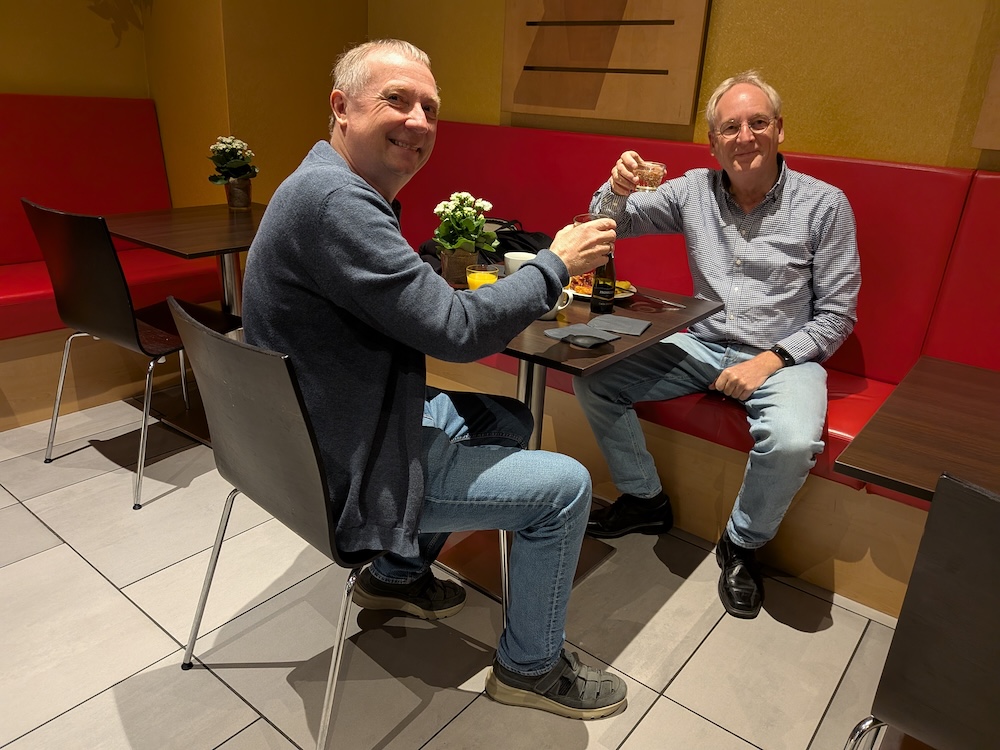
On October 1st, the ERC AdG project GT4Pebbles started officially. Carsten Dominik and Jürgen Blum meet in a hotel lobby in Leiden, to celebrate and update each other.
None
 June 17, 2025
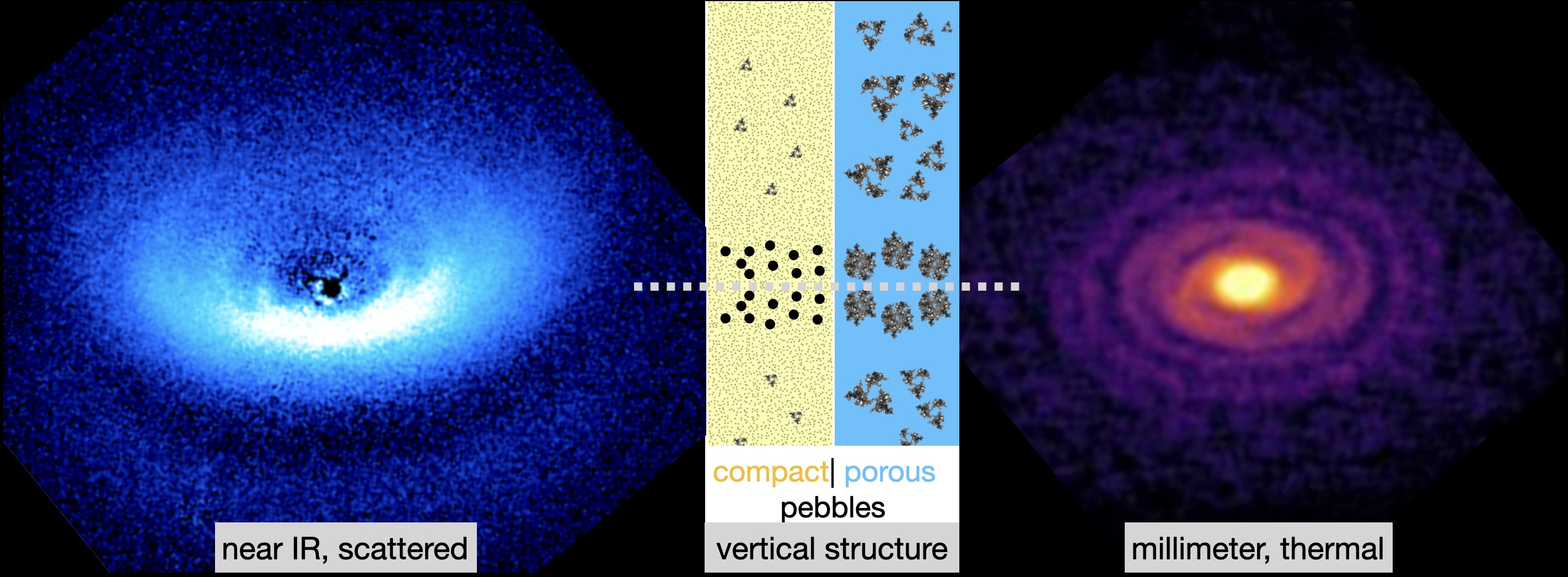
The discovery of exoplanetary systems has triggered a boost in the development of planet formation models. Most of these models rely on the presence of so-called pebbles – dust aggregates that have grown and been compacted in just the right way to be dynamically loosely coupled to the gas in the planet-forming disk. Only then do they enable key processes that produce planetary seeds and grow them efficiently into planets, overcoming growth barriers and enormous time scale problems. The models require that conversion of micron-sized dust particles into pebbles is global, efficient and fast. However, this is currently an unproven assumption that renders base assumptions of these models as shaky. GT4Pebbles will answer the following questions: - Do pebbles with useful properties for planet formation actually form, and with sufficient abundance? - What are the quantitative properties of these pebbles, and the consequences for planet formation models, disk observations and disk mass measurements? Building upon my recent advances in modeling and disk observations, and on advances in experimental technology in our partner laboratory, we will develop the first full-size range fractal dust-agglomeration experiment. We will gain comprehensive insights into the formation and properties of dust aggregates without relying on extreme extrapolations. By integrating experimental results with advanced numerical models, we will derive the structural, mechanical and optical properties of these aggregates as they evolve into pebbles. We will create a robust global dust growth model that for the first time meticulously accounts for porosity and compaction phenomena. This research will enable us to identify and characterize the initial seeds crucial for planet formation models in disks, providing valuable contributions to our understanding of planetary-system formation. With GT4Pebbles, planet formation models will no longer be “built on sand”, but on a solid foundation.
Credit: Dominik.